
SEO is still essential but it’s no longer enough to show up in AI-generated answers.
Your potential customers no longer automatically type ” plumber Liège ” into Google. More and more, they ask ChatGPT directly, or settle for the summary Google displays at the very top of the page (the AI Overview) without clicking on a single link. You’ve probably already seen that AI-generated block of text at the top of your Google results: that’s a Google AI Overview. In the United States, these AI-generated answers went from 6.5% to over 13% of Google searches in just two months in early 2025 and, according to Adobe, 77% of Americans who use ChatGPT already use it as a search engine.
That said, traditional Google results are still a major source of traffic, and classic SEO (useful content, expertise, regular updates) remains the foundation of any visibility strategy. What’s changing is that you now need to add an extra layer: being visible not only on Google, but also through generative AI tools like ChatGPT, Perplexity or Copilot. This is called GEO, short for Generative Engine Optimization. SEO is still the foundation; GEO builds on top of it.
In practice, SEO aims to get you listed in search results, while GEO aims to get you quoted in an answer the AI has already written. Both rely on the same foundation: clear, well-structured and reliable content. Only the goal is different: SEO is after the click, GEO is after the citation. In our previous article on the new Search Console report, we explained how to measure your visibility in these answers. Measuring is one thing. You still need to get cited.
Here are four things you can check yourself, no technical skills required.
Make sure AI tools can access your website
ChatGPT, Claude and Perplexity send their own bots across the web (OAI-SearchBot, ClaudeBot, PerplexityBot…). If those bots are blocked, your website stays invisible to them, however good it is.
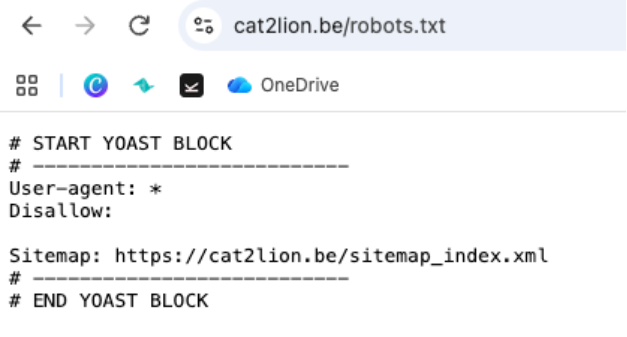
- Type “yourwebsite.be/robots.txt” into your browser. If you see “Disallow: /” under GPTBot, ClaudeBot or PerplexityBot, ask whoever manages your website to remove that block
- Make sure your key information is actual text. Opening hours in an image, or an address only shown on a map: your customers can see them, bots can’t
Answer your customers’ questions
When you ask an AI something, it looks for clear answers, not sales pages. The more directly your website answers questions, the more reasons it has to cite you.
- Write down the 5 questions you get asked most often, by phone, in store or by email, and add them as an FAQ on your website
- Answer in two or three sentences, straight to the point
- Put the key information first under each heading, and the details after. Whenever you can, use a list rather than a long paragraph: it’s easier for an AI to pick up
Get recognised as a local business
When someone asks for “an accountant in Liège”, the AI looks for businesses clearly tied to that area. To decide, it cross-checks everything it can find about you, not just your website.
- Spend 15 minutes on your Google Business Profile: up-to-date opening hours, a description that mentions your town and your line of work, a few recent photos, replies to your latest reviews
- Type your business name into Google and check the top results: website, Facebook, LinkedIn, directories. Your name, address and phone number should be exactly the same everywhere
- Mention your service area in the very first sentence of your “About us” page
Show who’s behind your content
Generic content with no one behind it is unlikely to be picked up. AI tools, like readers, place more trust in someone who knows their trade.
- Sign your articles with your name, your job title and a two-line bio
- Give the source of every figure you quote
Run the test
Ask ChatGPT three questions your customers might ask, for example “Who’s a good [your trade] in [your town]?”. Note whether you show up, and run the test again in a month.
Key takeaways: 3 things to do
- Check your robots.txt
- Update your Google Business Profile
- Add an FAQ with your customers’ 5 most common questions
Is your website ready for AI-powered search?
At cat2lion, we build these checks right into our digital audits and our generative engine optimisation strategies. Not sure whether AI tools are citing you? Contact us: we’ll look at where you stand together, on Google and on AI alike.
Sources
- Frissard, L. (2026, May 17). Statistiques Google 2026 : recherches, PDM et AI Overviews. Digitiz. https://digitiz.fr/statistiques-google/
- Eskimoz, & Lacoste, J. (2026, April 24). Optimisation pour les moteurs génératifs (GEO) : guide pour améliorer son référencement sur les moteurs d’IA. francenum.gouv.fr. https://www.francenum.gouv.fr/guides-et-conseils/communication-et-publicite/referencement/optimisation-pour-les-moteurs
- Mastering Generative Engine Optimization in 2026: Full guide. (2026, February 23). Search Engine Land. https://searchengineland.com/mastering-generative-engine-optimization-in-2026-full-guide-469142
- Lerat, V. (2026, September 13). EEAT. Abondance. https://www.abondance.com/definition/eeat
- Ligeron, P. (2026, March 25). Robots.txt et bots IA : comment protéger votre contenu sans disparaître des moteurs génératifs. Neper. https://www.neper.fr/2026/03/25/gptbot-claudebot-perplexitybot-gerer-le-crawl-des-agents-ia-dans-son-robots-txt/
- Vigreux, M. (2025, July 4). IA générative : pourquoi votre site internet reste plus stratégique que jamais. Les Echos Solutions. https://solutions.lesechos.fr/tech/innovation/ia-generative-pourquoi-votre-site-internet-reste-plus-strategique-que-jamais/
- Ferahtia, M. (2026, September 28). Qu’est-ce que les AI Overviews de Google : comment ça marche et s’y rendre visible ? Webconversion. https://www.webconversion.fr/ai-overview-google/